For a seasonal collection, the supplier's calendar matters more than its catalogue. A manufacturer that cannot show you how its peak-season work is scheduled, with sampling, stability, filling and shipping planned in parallel, is a schedule risk no matter how good its samples smell. Evaluate for repeatability under time pressure, not for the best single sample. That shift in focus is what keeps a fixed launch date intact.
Key takeaways
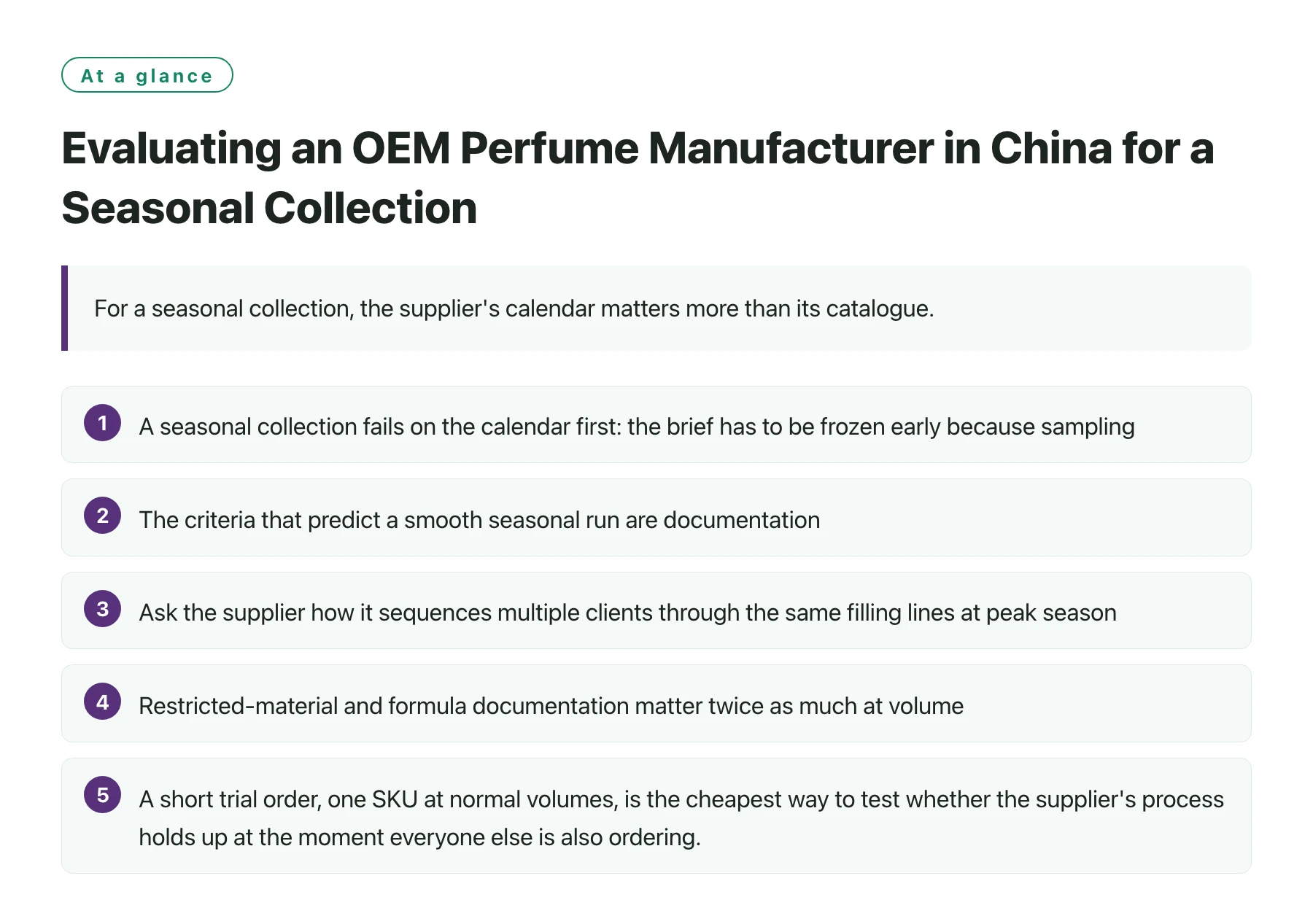
- A seasonal collection fails on the calendar first: the brief has to be frozen early because sampling, stability, decoration and shipping all compete for the same weeks near the peak.
- The criteria that predict a smooth seasonal run are documentation, communication discipline and capacity planning, not the number of scents in the catalogue.
- Ask the supplier how it sequences multiple clients through the same filling lines at peak season; a written answer beats a confident one.
- Restricted-material and formula documentation matter twice as much at volume, because a compliance problem discovered after production cannot be fixed inside the season.
- A short trial order, one SKU at normal volumes, is the cheapest way to test whether the supplier's process holds up at the moment everyone else is also ordering.
Seasonal collections are the reason a lot of buyers first consider an OEM manufacturer in China: the capability is real, the price structure can work, and the distance, in time zones and transit, forces a more disciplined plan than a local supplier might need.
The risk is not the factory's skill. It is the calendar. This article is about how to evaluate a supplier when your launch date is fixed, what to verify before the deposit, and which signals at the evaluation stage predict how the supplier behaves in the final weeks before shipping.
Plan the season backward from the shelf date
- Freeze the briefSet the collection's scents, sizes and price points before approaching suppliers so every comparison starts from the same document.
- Reserve the sampling windowBook the development and sampling phase early; iteration rounds consume calendar time that no contract can invent later.
- Lock stability and testingGive the finished product its full conditioning period; a shortened test is not a shorter schedule, it is a different product.
- Schedule decoration and fillingConfirm how the supplier allocates lines at peak; decoration is often the real bottleneck and deserves the same capacity question.
- Build the shipping bufferHold transit and customs as a fixed block, and let production dates be squeezed before it, never after.
What to evaluate, and what a strong answer looks like
| Criterion | Ask the supplier | A strong signal |
|---|---|---|
| Compliance scope | Which standards does your quality system actually hold? | A named GMP framework and a document pack ready to show |
| Material restrictions | How do you apply industry usage limits to formulas? | A documented review against the current restrictions [1] |
| Batch traceability | Walk me through one batch record | Raw material to release documented with dates and signatures |
| Peak-season capacity | How are clients sequenced when lines are full? | A written scheduling policy and honest answers about conflicts |
| Quality evidence | Who tests the finished product? | Named tests and access to test reports [2] |
Score the supplier on the table before you smell a single sampler. The sampler proves the perfumer; the table proves the factory, and it is the factory that has to survive the season.
What actually kills a seasonal launch
Two things kill seasonal launches, and neither is the scent. The first is a compliance surprise discovered after production: a restricted material, a missing ingredient on the file, a labelling mismatch. The second is a capacity surprise at the filling line, usually silent until the week the goods were promised.
Both surprises are detectable at the evaluation stage if you ask the right questions, which is why the table above exists. When you look at a manufacturer that supports both booking models, a manufacturer that supports OEM and ODM, the evaluation question is the same: can they show you, in writing, how a project like yours is scheduled, documented and quality-checked?
The trial order as an evaluation tool
If the evaluation table passes, the next test is a small, real order placed at a deliberately awkward moment, a normal SKU at normal volumes, but timed so you can watch the supplier handle the paper trail and the calendar under actual demand.
A supplier that treats the trial order as the start of a file rather than a transaction shows you the batch record, the release check and the shipping documents without being asked twice. That behaviour is the one you want when the season peaks.
Two things belong in the agreement from the start: a summary of the supplier's capacity at peak and how it communicates delays. production capacity and lead times explains why capacity is the first thing to pin down before committing to a fixed-date collection.
For a seasonal collection, evaluate the supplier the way you would evaluate a calendar: ask what happens when everything is due at once. A written answer about capacity, sequencing and documentation is the single most valuable document in the entire evaluation.
Where a strong candidate shows itself
A candidate shows its quality in the evaluation meeting by producing documents instead of promises. Certification numbers, batch records, an ingredient policy and a written scheduling answer are all things you can hold and verify.
A manufacturer that publishes this material openly is easier to evaluate because there is something concrete to check. A supplier such as Xuelei OEM perfume manufacturer in China that lists its standards and service scope lets you verify the claims before you ask a single question, which is exactly the position you want when the season is closing in.
Sources
- IFRA Standards Library (International Fragrance Association) —— The IFRA Standards Library lists the restrictions the fragrance industry applies to individual fragrance ingredients, based on safety assessments; it is the reference point for compliant fragrance formulation.
- SGS: Cosmetics, Personal Care & Household Testing —— Testing, inspection and certification services for cosmetics and personal care, including microbiological, stability and safety testing aligned with cosmetics GMP.
Frequently asked questions
How early should I start for a seasonal perfume collection?
Start with enough runway for the whole chain: briefing, sampling, stability, production and transit. The most common mistake is treating the launch date as if it only needs production time; documents and tests need calendar time of their own.
How many suppliers should I evaluate for a fixed-deadline project?
Three is a practical number. Send the identical brief to each, then compare their written answers to the same evaluation questions, capacity, compliance, documentation, rather than comparing samples alone.
What is the difference between OEM and ODM when time is short?
ODM reuses existing development, so the road to a first sample is usually shorter; OEM starts from your formula or brief, which takes longer but gives you more control. For a seasonal collection with a hard date, the shorter road often wins.
Can I trust a supplier's quality certificates?
Certificates are a starting point. Ask for the certificate number and issuing body, verify them independently, and then ask for a batch record to see the system working on a real run.
What should the trial order test?
The trial order should test process, not product: a batch record that appears without prompting, a release check that matches the quoted tolerance, and shipping documents that arrive on schedule. If those three hold on a small order, the supplier is ready for the season.